Why Testing Matters for Homeschoolers
You know your child better than any test ever will. But the right assessment gives you a map — so you can teach with precision, advocate with confidence, and prepare them for what’s ahead.
- 01 Testing Gives You Clarity, Not Judgment →
- 02 How Does Your Kid Actually Stack Up? →
- 03 The Gaps You Don’t Know About Are the Ones That Hurt →
- 04 Testing and the Path to College →
- 05 Managing Test Anxiety →
- 06 Does Your State Require Testing? →
- 07 Most Tests Give You a Score. HSTT Tells You What to Do With It. →
Testing Gives You Clarity, Not Judgment
A test score isn’t a grade on your parenting. It’s just information, and the right information makes you a better teacher.
A lot of homeschool parents dread testing because they’re afraid of what a score might say about them. But a good assessment isn’t there to judge you. It’s there to help you. Think of it less like a report card and more like a check-up. You’re not looking for a verdict. You’re looking for a clear picture.
What does a test actually tell you? Real stuff, like: Is my kid where they should be in math for their age? Are they flying in reading but hitting a wall with writing? Are they way ahead in science? Those answers are worth a lot more than a gut feeling when you’re deciding what to teach next year.
A test score reflects years of learning, not one morning’s performance. It’s not a grade on your teaching. It’s a data point. Use it like one.
How Do Your Kids’ Academic Performance Actually Stack Up?
Homeschoolers tend to do really well on standardized tests. But knowing that homeschoolers do well doesn’t tell you much about your kid specifically, and that’s what actually matters.
Where the average homeschooler ranks on the Iowa Test of Basic Skills
Above the national SAT average for homeschool students
Average homeschooler ACT score, compared to a 21 national average
Of colleges say standardized test scores are considerably important for admissions
Yes, homeschool kids outperform public school averages across most major tests. That’s great, but it’s also a general trend, not your family’s story. What you really want to know is how your child is doing in the specific subjects you’re teaching, compared to kids their age.
That’s what HSTT shows you. Not just “Math: 84%” but which parts of math your kid has down cold and which ones still need work. Things like fractions, geometry, number sense. It’s the difference between a vague thumbs-up and actually knowing what’s going on.

The Gaps You Don’t Know About Are the Ones That Hurt
Sometimes everything looks fine until it doesn’t. A solid overall score can hide real weak spots that will cause problems later if you don’t catch them now.
Here’s something that catches a lot of parents off guard: a kid can score 75% on a math test and still have a serious gap in fractions. How? They make up for it by doing great in geometry and measurement. The overall score looks totally fine. The problem is hiding underneath.
And that gap doesn’t stay small. If fractions are shaky in 4th grade, pre-algebra gets hard in 6th. By 8th grade, algebra is a real struggle and nobody can figure out why. Catch it in 4th grade and it’s usually just a few weeks of focused review. Miss it and it becomes a much bigger thing to untangle.
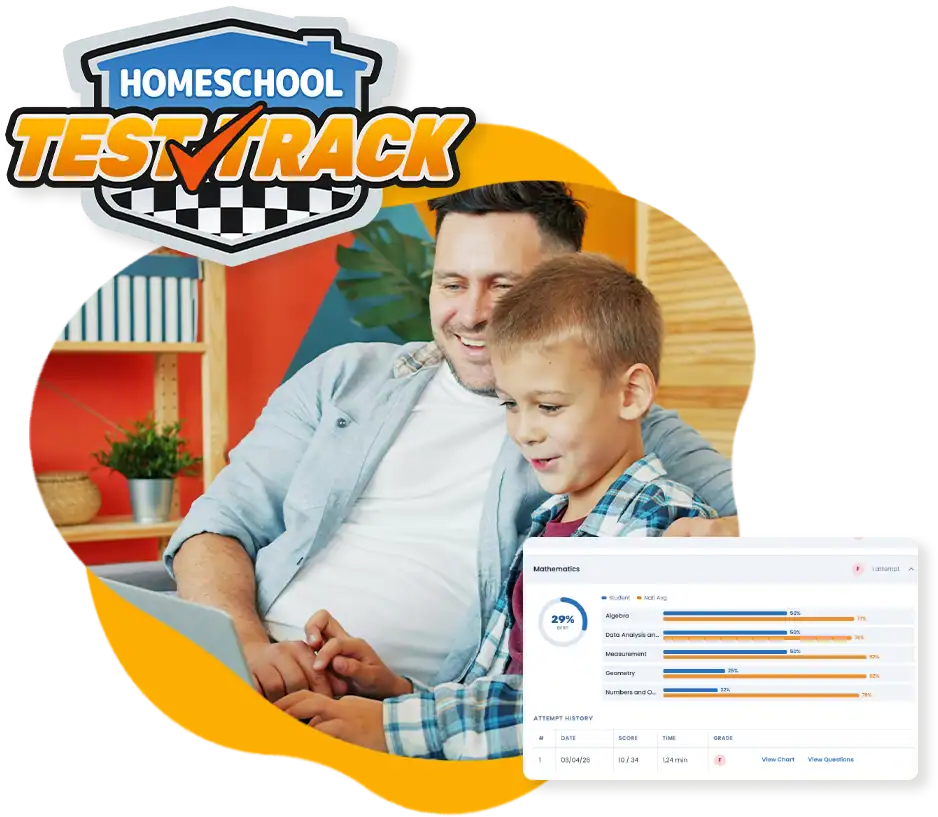
The HSTT Parent Dashboard shows you a Strengths & Gaps breakdown for each child. You see exactly which topics they’re ahead in and which ones need attention. No guesswork, no math required.
Testing and the Path to College
When your kid applies to college, test scores matter more for homeschoolers than for almost anyone else. You don’t have a school counselor or a third-party transcript backing you up.
A kid coming out of a traditional school has a transcript, a class rank, grades from multiple teachers, and a counselor’s recommendation. Colleges know how to read all of that. A homeschool student often has a parent-issued transcript, which colleges take seriously, but it doesn’t carry the same independent weight. Test scores fill that gap. They’re one of the clearest ways to show a college admissions office that your kid is ready.
And it’s not just about getting in. Higher test scores mean more scholarship money. The difference between a decent score and a great one can be thousands of dollars a year. Starting to build those test-taking skills now with lower-stakes subject tests is one of the most practical things you can do.

College Admissions
About 78% of colleges say test scores are considerably important in their admissions process. For competitive schools, they’re often what tips the scale for homeschool applicants.
Scholarship Money
Higher SAT and ACT scores are directly tied to bigger merit scholarships. Better scores can take real money off the cost of college.
Getting Comfortable With Tests
Kids who take tests regularly aren’t thrown off by the format, the time pressure, or the nerves. That comfort level doesn’t happen on its own. It comes from practice.
A Record You Can Stand Behind
Annual test results give you a real academic paper trail, useful for college applications, co-ops, dual enrollment, or if your child ever re-enters a traditional school.
One more thing worth knowing: more than 80% of Fortune 500 companies use standardized assessments in their hiring process. Learning to perform well on tests isn’t just a school skill. It’s a life skill.
Managing Test Anxiety
Test anxiety is real. A lot of kids have it. The answer isn’t to avoid tests. It’s to make them less of a big deal by doing them more often.
About 61% of high school students deal with some level of test anxiety, and for 26% it seriously affects how they perform. For homeschool kids who don’t take formal tests very often, that number is probably higher because the whole experience feels unfamiliar and high-stakes when it only happens once in a while.
The fix isn’t protection. It’s familiarity. Kids who take tests regularly stop seeing them as a threat. They know what to expect, they know how to pace themselves, and they go in with some confidence. That only happens with practice, not from a pep talk the night before.


Even if your state doesn’t require it, testing is still worth doing. It gives you a real picture of where your child is, helps them build test-taking skills they’ll need later, and creates an academic record that comes in handy for college applications, co-op programs, or if they ever go to a traditional school.
Does Your State Require Testing?
It depends on where you live, and the answer matters. Some states require annual tests. Others have zero requirements. Either way, it’s worth knowing before you decide to skip it.
About half of U.S. states require homeschool families to do some form of standardized testing. States like Massachusetts, New York, Pennsylvania, and Rhode Island have strict annual requirements. States like Texas, Idaho, Michigan, and New Jersey leave it entirely up to you.
Even if your state doesn’t require it, testing is still worth doing. It gives you a real picture of where your child is, helps them build test-taking skills they’ll need later, and creates an academic record that comes in handy for college applications, co-op programs, or if they ever go to a traditional school.
Most Tests Give You a Score. Homeschool Test Track You What to Do With It.
Any test can tell you how your kid did. HSTT shows you where they stand, what they’ve got down, and exactly where to go from here.
There are plenty of standardized tests out there for homeschool families. What’s been missing is a platform that takes those results and actually makes them useful. A dashboard built for parents that shows you patterns over time, breaks down scores by topic, and tells you what it all means without requiring a degree to interpret.
Scores by Topic
Every test is broken down into specific sub-topics. You see exactly what your kid knows and what they’re still working on, not just one big number.
National Benchmarks
Your child’s results are compared to benchmarks from national research, so you always have a real frame of reference for each subject.
You Control What They See
You decide when your child sees their scores. Review results yourself first, then share them when you’re ready.
Every Kid Gets Their Own Login
Each child has their own student account. You manage everything from one parent dashboard with option to log in to student accounts from there, or have them sign in.
Full Test History
Every attempt is saved. Watch how your child’s performance in each topic changes over time so you catch problems early instead of being surprised later.
Strengths & Gaps, Spelled Out
HSTT automatically flags the topics where each child is ahead and where they’re falling behind. It’s already done the analysis. You just read it and act on it.
Ready to See the Full Picture?
Join homeschool families using Test Track to teach with confidence, catch gaps early, and set your kids up for what comes next.
Ready to start? Take the first step:
-or-