Why Homeschool Learning Assessments Matter
You see your child learning every day. Homeschool Test Track helps you see which skills they understand, where more practice could help, and how their results compare with the national average. Use that insight to focus your teaching and follow their progress over time.
Understand Your Child’s Learning
An assessment score isn’t a grade on your parenting. It’s information you can use to support your child’s learning.
It’s understandable to feel nervous about reviewing your child’s results. You’ve put time and care into their education, and a score can feel personal. But the purpose of an assessment is to help you understand what’s working and where your child could use more support.
Are they comfortable with math skills for their grade? Does reading come easily while writing needs more practice? Are they showing particular strengths in science? Those details help you make more informed decisions about lessons, review, and what to teach next.
Consider each result alongside your daily observations and previous assessments. Together, they give you a clearer picture than any single score can provide.
Put Their Progress in National Context
Knowing how homeschool students perform overall is interesting. Understanding how your own child compares is what helps you teach.
Where the average homeschooler ranks on the Iowa Test of Basic Skills
Above the national SAT average for homeschool students
Average homeschooler ACT score, compared to a 21 national average
Of colleges say standardized test scores are considerably important for admissions
Yes, homeschool kids outperform public school averages across most major tests. That’s great, but it’s also a general trend, not your family’s story. What you really want to know is how your child is doing in the specific subjects you’re teaching, compared to kids their age.
That’s what Homeschool Test Track shows you. Homeschool Test Track compares your child’s results against national benchmarks. Alongside their subject and topic scores, you can see how their performance compares with the national average. Use that comparison together with your child’s previous results and your own observations. You get a fuller picture of their learning, including strengths to recognize and areas to support.

Find Learning Gaps Before They Grow
A solid overall score can hide a specific skill that needs more attention.
For example, a child might score well in geometry and measurement while struggling with fractions. Those stronger areas raise their overall math score, making the difficulty with fractions less obvious.
Foundational skills matter because later lessons build on them. When a child struggles with a new concept, the issue may be an earlier skill that hasn’t fully clicked. Finding that gap gives you a chance to revisit it before moving further ahead.
The Homeschool Test Track Parent Dashboard shows a Strengths & Gaps breakdown for each child. You can see which topics are above the national average and which need attention, then use that information to guide review.
Testing and the Path to College
When your kid applies to college, test scores matter more for homeschoolers than for almost anyone else. You don’t have a school counselor or a third-party transcript backing you up.
A kid coming out of a traditional school has a transcript, a class rank, grades from multiple teachers, and a counselor’s recommendation. Colleges know how to read all of that. A homeschool student often has a parent-issued transcript, which colleges take seriously, but it doesn’t carry the same independent weight. Test scores fill that gap. They’re one of the clearest ways to show a college admissions office that your kid is ready.
And it’s not just about getting in. Higher test scores mean more scholarship money. The difference between a decent score and a great one can be thousands of dollars a year. Starting to build those test-taking skills now with lower-stakes subject tests is one of the most practical things you can do.

College Admissions
About 78% of colleges say test scores are considerably important in their admissions process. For competitive schools, they’re often what tips the scale for homeschool applicants.
Scholarship Money
Higher SAT and ACT scores are directly tied to bigger merit scholarships. Better scores can take real money off the cost of college.
Getting Comfortable With Tests
Kids who take tests regularly aren’t thrown off by the format, the time pressure, or the nerves. That comfort level doesn’t happen on its own. It comes from practice.
A Record You Can Stand Behind
Annual test results give you a real academic paper trail, useful for college applications, co-ops, dual enrollment, or if your child ever re-enters a traditional school.
One more thing worth knowing: more than 80% of Fortune 500 companies use standardized assessments in their hiring process. Learning to perform well on tests isn’t just a school skill. It’s a life skill.
Help Your Child Feel Comfortable With Assessments
For a child who feels nervous about assessments, a familiar routine and supportive approach can make a difference.
When formal assessments happen rarely, the experience may feel unfamiliar or carry more pressure than intended. Explain what your child will be doing and why: you want to understand what they know and find anything you can practice together.
Give them time to become familiar with the format. Choose a calm setting, offer encouragement, and talk about the results as information that helps you teach. Recognize their strengths as well as the topics that need another look.
Homeschool Test Track lets you review results before your child sees them. You can take time to understand their performance and decide how to share it constructively.

See the Skills Behind the Scores.
Understand what your child knows, how their results compare nationally, and what deserves attention next.
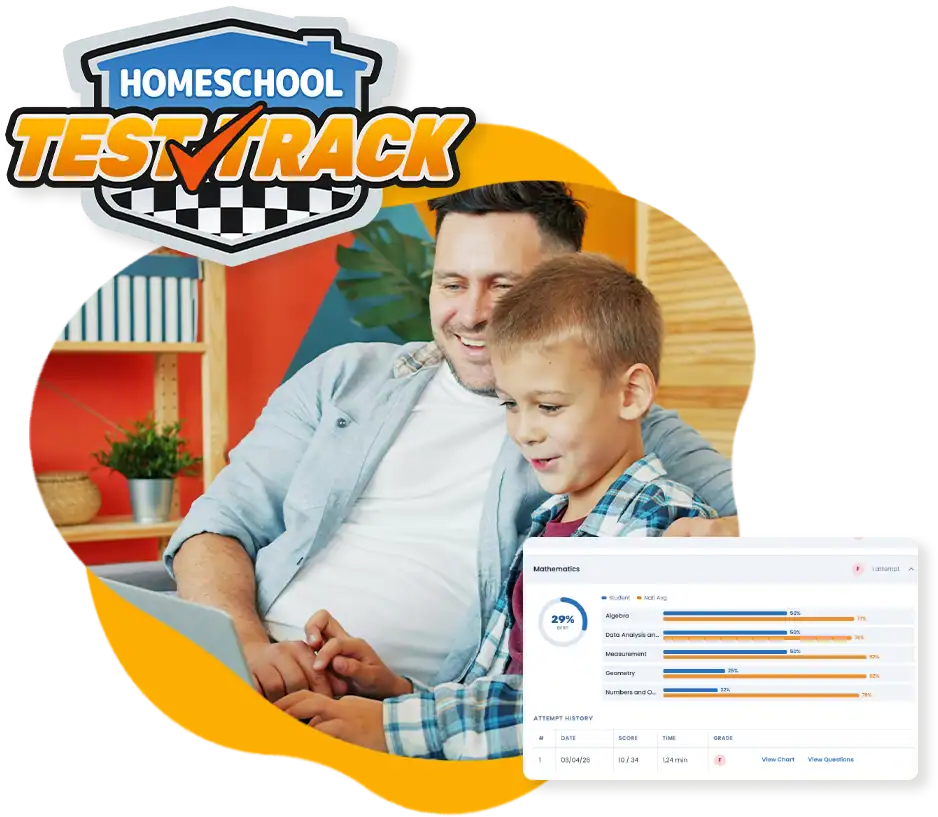
An overall score gives you a starting point. Homeschool Test Track adds the details that help you use it: topic breakdowns, national benchmarks, strengths and gaps, and a history of assessment attempts.
Everything comes together in a parent dashboard designed to help you review results and make informed teaching decisions.
Scores by Topic
See results for specific skills within each subject, giving you a clearer focus for lessons and practice.
National Benchmarks
Compare your child’s results against the national average for a meaningful frame of reference.
You Control What They See
Review results first and decide when your child sees their scores.
Individual Student Logins
Each child has their own account, while you manage their assessments and results from one parent dashboard.
Complete Assessment History
Follow performance across attempts to see what’s improving and which topics still need attention.
Strengths and Gaps Highlighted
Find the topics where your child performs above the national average and those where additional support may help.
Ready to See the Full Picture?
Get the insight to focus your teaching and support your child’s next steps. Homeschool Test Track brings detailed skill results, national benchmarks, and progress tracking together in one place.
Ready to start? Take the first step:
-or-